US Bill Seeks to Ban Political Betting on Prediction Markets

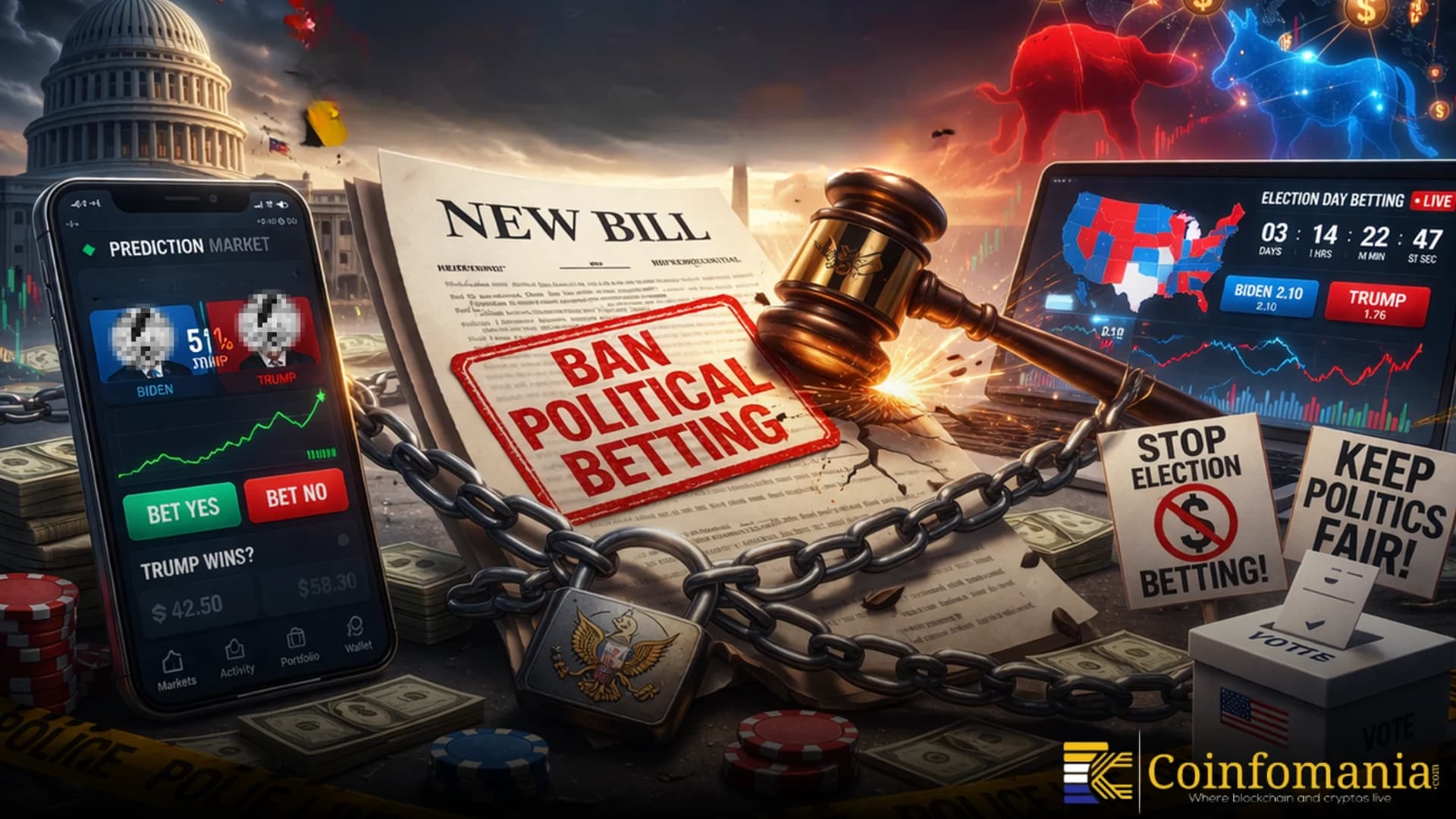
US lawmakers introduced the PREDICT Act to prohibit the President and Congress from trading on prediction markets.
Quick Take
Summary is AI generated, newsroom reviewed.
The PREDICT Act prohibits Members of Congress, the President, and political appointees from betting on political outcomes or government actions.
Restrictions extend to spouses and dependent children to prevent the use of sensitive, non-public information for personal financial gain.
Violations carry a civil penalty of 10% of the transaction value plus the full forfeiture of all profits to the U.S. Treasury.
The bill follows reports of "insider" profits on Polymarket and Kalshi regarding military strikes in Iran and Venezuela.
Two U.S. lawmakers have introduced a new bill to limit political betting. The proposal aims to stop top officials from using inside information for profit. The bill is called the Preventing Real-time Exploitation and Deceptive Insider Congressional Trading Act, or PREDICT Act. It was introduced by Adrian Smith and Nikki Budzinski.
U.S. Representatives Adrian Smith and Nikki Budzinski have introduced a bipartisan bill, the PREDICT Act, which seeks to ban the president, vice president, members of Congress, and political appointees — along with their spouses and dependents — from wagering on prediction… pic.twitter.com/oPXNJkhasO
— Wu Blockchain (@WuBlockchain) March 26, 2026
The effort has support from both political parties. This shows growing concern about fairness and transparency in government. At its core, the bill targets prediction markets. These platforms allow users to bet on future events, including elections and policy decisions.
Who the Ban Would Cover?
The PREDICT Act focuses on high-level officials. This includes members of Congress, the president and the vice president. It also covers political appointees in the executive branch. In addition, spouses and dependent children are included.
If passed, this law would prohibit these individuals from placing bets on political outcomes. This includes elections, laws and government actions. Lawmakers say they need this step because they believe officials should not use public service for personal financial gain. Their simple goal ensures that leaders make decisions for the public good rather than for profit.
Penalties for Breaking the Rules
The bill also sets clear penalties. Anyone who breaks the rule could face financial consequences. Violators may have to pay a fine equal to 10% of the contract value. Additionally, they would lose any profits made from the bet.
These penalties aim to act as a strong deterrent. Lawmakers want to send a clear message that they will not tolerate insider betting. Even as they discuss specific enforcement details. The final structure may change as the bill moves forward.
Why This Bill Matters Now?
Prediction markets have grown fast in recent years. Platforms like Polymarket and Kalshi have gained attention during major global events. These platforms offer a new way to track public opinion. But they also raise new risks. One major concern is insider knowledge. Government officials often have access to information before the public.
This creates a risk. They could place bets based on that knowledge. The PREDICT Act aims to close that gap. It builds on earlier debates about insider trading in stocks. Now, lawmakers want to apply similar rules to prediction markets.
What Comes Next?
The bill is still in its early stages. It must pass through Congress before becoming law. There may be debates along the way. Some may debate over how the laws should be applied. Others may dispute how to enforce them.
Still, the proposal highlights a bigger trend. Prediction markets are becoming a major focus for governments. As these platforms grow, rules will likely follow. Right now, the PREDICT Act sends a clear signal. Lawmakers seek to maintain public trust. Furthermore, they aim to ensure that no one misuses power for personal advantage.


Follow us on Google News
Get the latest crypto insights and updates.