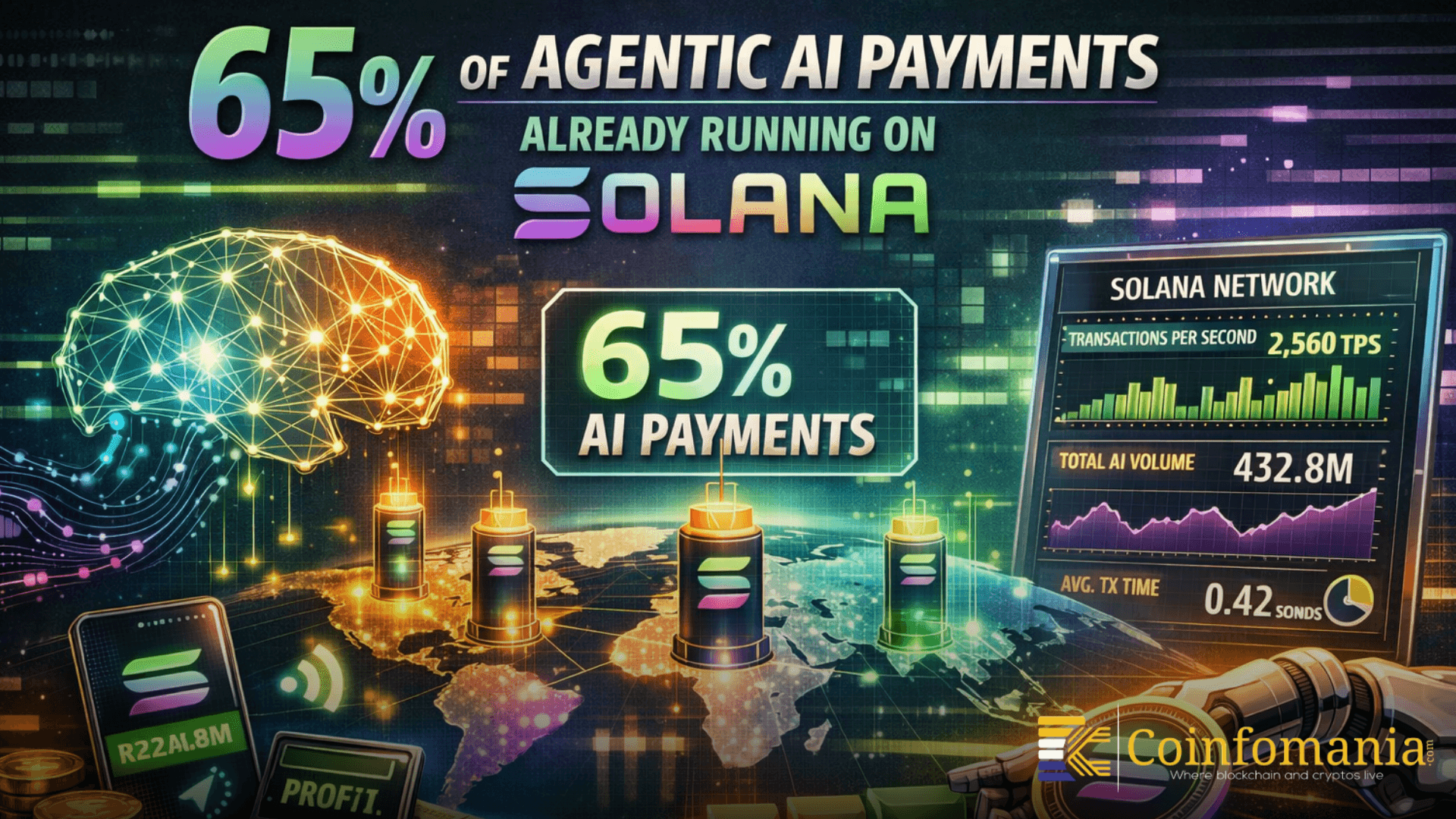
65% of Agentic AI Payments Already Running on Solana

Agentic AI payments increasingly concentrate on Solana due to speed, cost efficiency, and infrastructure advantages
Quick Take
Summary is AI generated, newsroom reviewed.
AI agents prefer Solana because it enables fast, low-cost microtransactions essential for autonomous operations
Around 65% of agentic AI payments in 2026 are now settled on Solana due to performance advantages
Growing ecosystem of SDKs, wallets, and Solana Pay is accelerating machine-to-machine crypto payments
Ethereum and Layer 2 networks remain competitive but are held back by fragmentation and higher friction
Something quietly remarkable happened in early 2026: roughly 65% of agentic AI payments are already running on Solana. Not Ethereum, not Arbitrum, not Base. Solana. While most of the crypto world spent 2025 debating memecoins and ETF inflows, autonomous AI agents were busy choosing their preferred settlement layer, and they overwhelmingly picked the chain that could keep up with them. This isn’t a narrative pushed by Solana’s marketing team. It’s an observable pattern emerging from on-chain data, SDK adoption rates, and the infrastructure choices made by the teams actually building autonomous agent frameworks. The implications for both the AI and crypto economies are significant, and they’re worth understanding in detail.
The Rise of Autonomous Finance: Solana’s Dominance in Agentic AI
Defining Agentic AI and On-Chain Execution
Agentic AI refers to autonomous software agents that can independently make decisions, execute tasks, and manage resources without continuous human oversight. Unlike traditional AI assistants that respond to prompts, agentic systems operate with persistent goals: they can browse the web, call APIs, manage budgets, and critically, spend money. The “on-chain” part matters because these agents need a trustless, programmable financial layer. A traditional bank account requires a human signatory. A credit card requires KYC. But a blockchain wallet can be controlled entirely by code, making it the natural payment rail for software that needs to transact autonomously.
When an AI agent needs to pay for compute, purchase data, or compensate another agent for a completed task, it needs a settlement system that’s fast, cheap, and programmable. Smart contract platforms fit this requirement perfectly. The agent holds tokens in a wallet, signs transactions programmatically, and settles payments in seconds. This is the fundamental reason blockchain and agentic AI are converging: not because of hype, but because of a genuine infrastructure need.
Analyzing the 65% Market Share Milestone
The figure itself comes from aggregated data across major agentic AI frameworks, including Solana’s own ecosystem reports and third-party analytics from platforms like Dune and Artemis. By Q1 2026, Solana-based agent transactions accounted for approximately two-thirds of all on-chain agentic AI payment volume. This includes agent-to-agent payments, agent-to-service payments, and autonomous treasury management operations.
What makes this number striking isn’t just its size but its velocity. In mid-2025, Solana’s share of agentic payments hovered around 35-40%. The jump to 65% happened in roughly eight months, driven by a combination of infrastructure maturity, developer tooling improvements, and a self-reinforcing network effect: as more agents settled on Solana, more services built for Solana agents, which attracted more agents. The remaining 35% is split across Ethereum mainnet (about 12%), Base (roughly 10%), Arbitrum (8%), and a long tail of other chains. Solana’s dominance here mirrors what happened with DeFi on Ethereum in 2020: once a critical mass of activity concentrates on one chain, the gravitational pull becomes hard to escape.
Technical Advantages Fueling the AI-Solana Synergy
High Throughput and Low Latency for Real-Time Decisions
AI agents don’t operate on human timescales. A well-designed agent can evaluate options, make a decision, and need to execute a payment in under a second. Solana’s block time of roughly 400 milliseconds and theoretical throughput exceeding 65,000 transactions per second make it uniquely suited for this kind of real-time autonomous operation. Compare that to Ethereum’s 12-second block times or even Layer 2 solutions that still introduce sequencer delays.
For an agent managing a portfolio, arbitraging information markets, or purchasing API calls from competing providers, latency is a competitive disadvantage. An agent waiting 12 seconds for transaction confirmation is an agent losing money. Solana’s architecture, built on Proof of History combined with Tower BFT consensus, was designed for speed from the ground up rather than retrofitted for it.
Micro-Transaction Viability with Sub-Cent Fees
This is arguably the most important factor. Agentic AI payments are overwhelmingly small. An agent paying another agent for a data query might transact $0.002. An agent purchasing a few seconds of GPU compute might spend $0.05. On Ethereum mainnet, where gas fees still regularly exceed $1 for simple transfers, these transactions are economically impossible. Even on Layer 2 networks, fees of $0.01-0.05 can represent a significant percentage of the transaction value.
Solana’s average transaction fee sits around $0.00025 in 2026. That means an agent can execute thousands of micro-payments daily without fee overhead eating into its operational budget. This isn’t a minor convenience: it’s a structural requirement. The entire agentic economy depends on viable micro-transactions, and Solana currently delivers that better than any alternative.
Key Infrastructure Driving AI Agent Adoption
SDKs and Frameworks for Autonomous Wallets
The raw blockchain performance would mean little without developer tools that make it easy to build agent-compatible wallets and payment flows. Several frameworks have emerged as standards in this space. SendAI’s Solana Agent Kit, which launched in late 2025, provides pre-built modules for wallet creation, token swaps, staking, and payment scheduling, all designed to be called by AI agent frameworks like LangChain, AutoGPT, and CrewAI.
Crossmint’s agent wallet infrastructure deserves mention too. Their API allows developers to spin up Solana wallets for AI agents programmatically, with built-in guardrails like spending limits and approved token lists. This kind of tooling abstracts away the complexity of key management and transaction signing, letting AI developers focus on agent logic rather than blockchain plumbing. The abstraction layer is critical: most AI developers building agents aren’t crypto-native, and they shouldn’t need to be.
The Role of Solana Pay in Machine-to-Machine Commerce
Solana Pay, originally designed for point-of-sale merchant payments, has found an unexpected second life as a machine-to-machine payment protocol. Its transaction request specification allows agents to encode complex payment instructions, including conditional payments, split payments, and payment-with-metadata, into standardized formats that other agents can parse and verify.
Several agent marketplaces now use Solana Pay as their default settlement protocol. When an agent on a platform like Fetch.ai or Autonolas needs to compensate a service provider agent, the transaction flows through Solana Pay’s infrastructure. The protocol handles token transfers, receipt generation, and on-chain verification in a single atomic operation. This standardization reduces integration friction and creates a common language for agent commerce.
Case Studies: Successful AI Agents Operating on Solana
A few concrete examples illustrate how this ecosystem actually works in practice. Griffain, launched in early 2026, operates as an autonomous DeFi management agent on Solana. Users delegate capital to Griffain agents, which then independently manage yield farming positions across protocols like Marinade, Raydium, and Orca. The agent executes dozens of micro-transactions daily, rebalancing positions and harvesting rewards, something that would be prohibitively expensive on higher-fee chains.
AIXBT, originally a social trading signal bot, evolved into a fully autonomous trading agent that manages its own Solana wallet. It analyzes social sentiment, on-chain data, and market microstructure to execute trades without human intervention. In Q1 2026, AIXBT processed over 140,000 autonomous transactions on Solana.
Then there’s the emerging category of “agent swarms” on platforms like Virtuals Protocol, where multiple specialized agents collaborate on complex tasks. One agent might research, another might negotiate, and a third handles payment, all settling their inter-agent compensation on Solana. These swarms represent the most sophisticated use case for on-chain agentic payments, and they’re growing fast.
Challenges and the Competitive Landscape
Network Stability Requirements for Critical AI Tasks
Solana’s history of network outages remains a legitimate concern. While the chain has been significantly more stable since the Firedancer validator client began rolling out in late 2025, the network still experienced two notable degradation events in early 2026. For AI agents managing financial positions or executing time-sensitive tasks, even brief periods of network congestion or downtime can result in real losses.
The stakes are higher for autonomous agents than for human users. A person can wait and retry a failed transaction. An agent operating on a programmed schedule might misinterpret a timeout, double-execute, or fail to complete a critical multi-step operation. Agent developers are building redundancy layers, including fallback chains and transaction retry logic, but these add complexity and partially negate Solana’s speed advantages.
Emerging Rivalry from Layer 2 Solutions
Ethereum’s Layer 2 ecosystem isn’t standing still. Base, backed by Coinbase, has been aggressively courting AI agent developers with grants and dedicated infrastructure. Arbitrum’s Stylus upgrade enables agents written in Rust and C++ to run natively, which appeals to performance-focused AI teams. And Ethereum’s own roadmap, including EIP-4844 blob transactions, continues to push L2 fees lower.
The competitive threat is real but not yet existential for Solana. Layer 2 solutions still face fragmentation problems: an agent on Base can’t easily pay an agent on Arbitrum without bridging, which introduces delays, costs, and security risks. Solana’s single-chain architecture avoids this entirely. Every agent on Solana can transact with every other agent on Solana instantly, creating a unified liquidity and communication layer that fragmented L2 ecosystems struggle to match.
The Future of the AI-Crypto Economy
The concentration of agentic AI payments on Solana signals something bigger than one blockchain’s market share. It suggests that autonomous software agents are becoming genuine economic actors, entities that earn, spend, save, and invest without human involvement. By 2027, industry projections estimate the total on-chain agentic economy could exceed $10 billion in annual transaction volume, up from roughly $850 million today.
Solana’s current dominance isn’t guaranteed to last. The chain needs to maintain its performance edge, continue improving stability, and keep attracting the developer tooling that makes agent integration straightforward. But the first-mover advantage is substantial: with most of the agentic AI payment activity on Solana today, the ecosystem effects compound daily.
For developers, investors, and anyone paying attention to where crypto and AI genuinely intersect rather than just overlap in marketing decks, Solana’s position in agentic payments is the most important trend to watch in 2026. The agents have already voted with their wallets. The question now is whether the infrastructure can scale to match their ambitions.
Use up and down arrow keys to resize the meta box pane.


Follow us on Google News
Get the latest crypto insights and updates.