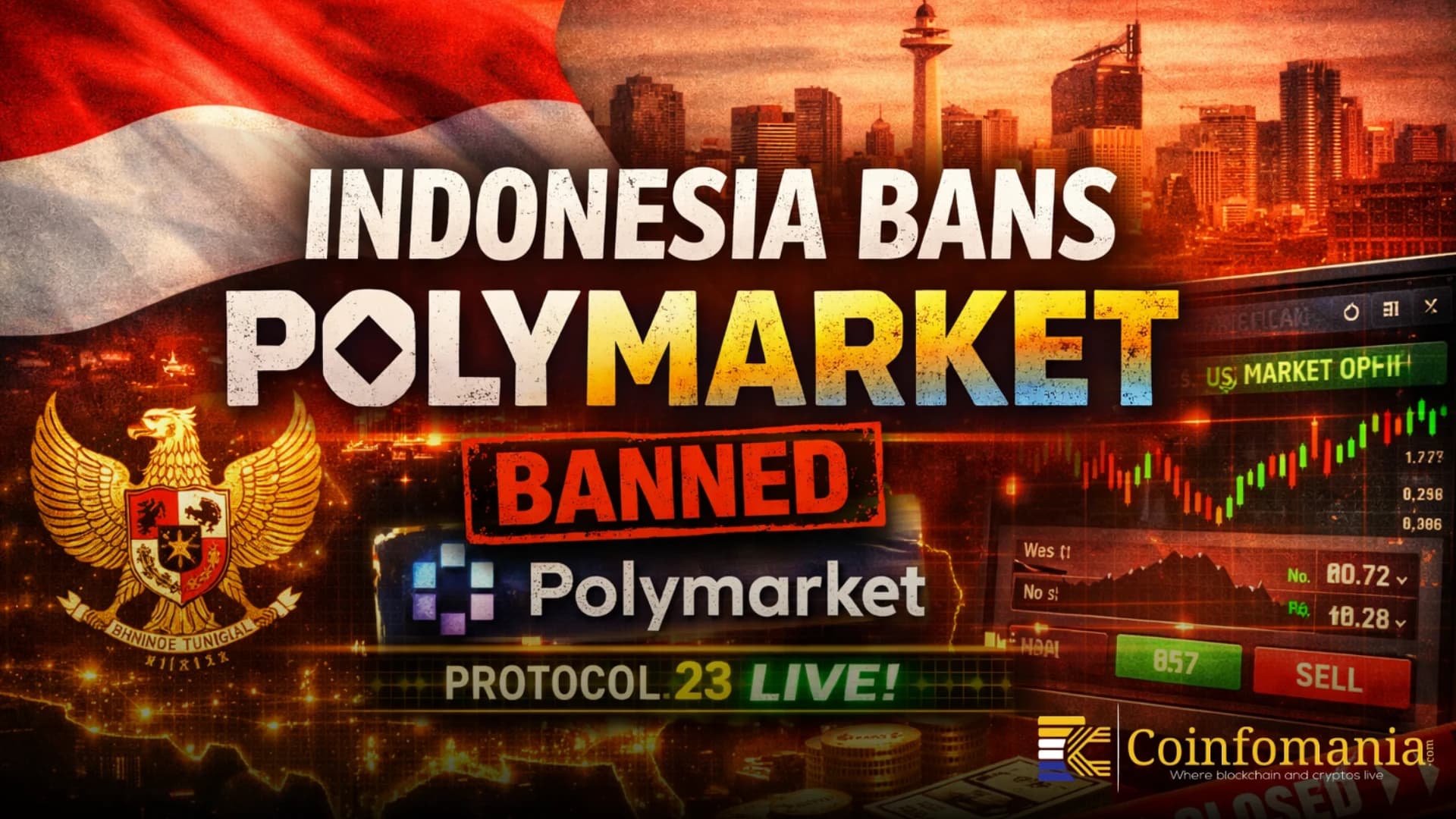
Indonesia Bans Polymarket as Illegal Online Gambling Prediction Market

Indonesia blocks Polymarket over gambling concerns, impacting crypto regulation, prediction markets and decentralized finance adoption.
Quick Take
Summary is AI generated, newsroom reviewed.
Indonesia blocked Polymarket after classifying prediction markets as online gambling
Authorities used national internet filtering systems to restrict platform access
The ban increased uncertainty surrounding decentralized finance and Web3 innovation
Southeast Asian regulators continue tightening oversight on crypto gambling platforms
Indonesia’s decision to block Polymarket sent shockwaves through the crypto community in Southeast Asia. The move, which classified the blockchain-based prediction platform as a form of illegal online gambling, wasn’t entirely surprising to anyone who has watched Indonesian regulators over the past few years. But the speed and firmness of the action caught many off guard, particularly given how popular the platform had become during recent election cycles. For a country with one of the fastest-growing internet populations on the planet, this ban raises uncomfortable questions about where governments draw the line between speculation, information markets, and outright gambling.
With over 210 million internet users and a young, tech-savvy population, Indonesia’s stance on prediction markets has implications far beyond its borders. The country’s approach could shape how other Muslim-majority nations and emerging economies handle similar platforms, creating a regulatory ripple effect across the Global South. What happened, why it matters, and what comes next: that’s what this piece is about.
The Crackdown on Polymarket in the Indonesian Digital Landscape
Indonesia has been tightening its grip on online platforms that fall outside its regulatory comfort zone for years. The ban on Polymarket fits neatly into a pattern of government action against platforms deemed socially or legally problematic, from pornography filters to the temporary TikTok Shop ban in 2023. What makes this case different is the intersection of cryptocurrency, gambling law, and political speech: three areas where the Indonesian government has shown little tolerance for ambiguity.
The timing also matters. Polymarket’s user base surged globally during the 2024 U.S. presidential election and continued growing through various 2025 and 2026 election cycles worldwide. Indonesian users were no exception. The platform’s accessibility through web browsers and crypto wallets made it trivially easy for anyone with a MetaMask account and some USDC to place bets on everything from election outcomes to central bank interest rate decisions.
Ministry of Communication and Informatics Regulatory Action
The Ministry of Communication and Informatics, known locally as Kominfo, issued the blocking order in early 2026 after a review period that reportedly lasted several months. Kominfo added Polymarket’s domain to its national DNS filtering system, the same mechanism used to block thousands of other websites deemed in violation of Indonesian law. The ministry cited Law No. 7 of 1974 on Gambling Control and Government Regulation No. 9 of 1981 as the legal basis for the action.
Kominfo’s statement was blunt: prediction markets that allow users to wager real monetary value on uncertain outcomes constitute gambling under Indonesian law, regardless of the underlying technology. The ministry made no distinction between Polymarket’s blockchain infrastructure and a traditional online sportsbook. From their perspective, the mechanism is irrelevant; the activity is what matters.
Internet service providers across Indonesia were given 72 hours to implement the block. Most complied within 48 hours. Users attempting to access Polymarket from Indonesian IP addresses now see a standard Kominfo block page directing them to information about the violation.
The Surge of Prediction Markets During Global Election Cycles
Polymarket’s explosive growth during the 2024 U.S. election cycle is well documented: the platform handled over $3.5 billion in trading volume around that single event. But the trend didn’t stop there. As prediction markets gained mainstream media attention, platforms like Polymarket, Kalshi, and newer entrants attracted users from regions where they had previously been obscure.
Indonesian users were drawn in by markets covering not just U.S. politics but also ASEAN regional events, commodity prices, and even weather patterns. The appeal was obvious: a way to monetize political knowledge and intuition that felt more like trading than gambling. Social media amplified the trend, with Indonesian crypto influencers openly sharing their Polymarket positions and winnings. That visibility likely accelerated the regulatory response. When a platform becomes popular enough that ordinary citizens are discussing it on Twitter and Telegram, governments take notice.
Categorizing Prediction Markets as Illegal Online Gambling
The core legal question is deceptively simple: is betting on whether a candidate wins an election fundamentally different from betting on whether a football team wins a match? Indonesian law says no.
Indonesia’s Strict Anti-Gambling Laws and Penalties
Indonesia has some of the strictest anti-gambling laws in the world, rooted in both secular law and Islamic principles. The country’s Criminal Code (KUHP), revised in 2023 with provisions taking effect through 2026, treats gambling as a criminal offense punishable by up to four years in prison. Online gambling carries similar penalties, and organizers or facilitators face even harsher sentences.
The legal framework makes no exception for prediction markets, decentralized platforms, or cryptocurrency-based wagering. Indonesian courts have historically interpreted gambling laws broadly, covering any activity where participants risk money on uncertain outcomes for potential profit. This interpretation leaves almost no room for prediction markets to operate legally, regardless of how they brand themselves.
Enforcement has also intensified. Indonesian police arrested over 1,200 individuals on online gambling charges in 2025 alone, and Kominfo blocked more than 800,000 gambling-related URLs that same year. The Polymarket ban is part of this broader crackdown, not an isolated incident.
Distinguishing Between Financial Trading and Betting
This is where the debate gets genuinely interesting. Polymarket and its supporters argue that prediction markets serve an informational purpose: they aggregate collective intelligence about future events and produce probability estimates that are often more accurate than polls or expert forecasts. The platform’s defenders point to academic research showing prediction markets outperform traditional forecasting methods.
Indonesian regulators aren’t buying it. Their position is straightforward: if you’re putting money at risk on a binary outcome and receiving a payout based on whether that outcome occurs, you’re gambling. The fact that the activity produces useful information as a byproduct doesn’t change its legal classification.
The distinction between financial derivatives trading, which Indonesia permits through regulated exchanges, and prediction market betting remains blurry globally. The U.S. Commodity Futures Trading Commission (CFTC) has spent years wrestling with this exact question regarding Kalshi and Polymarket. Indonesia chose not to wait for international consensus and instead applied its existing gambling framework directly.
Impact on the Local Cryptocurrency and Web3 Community
The ban on Polymarket as an illegal online gambling prediction market has sent a chill through Indonesia’s crypto ecosystem, which had been cautiously optimistic about the country’s regulatory direction.
Access Restrictions and Domain Blocking Measures
Kominfo’s DNS-level blocking is the primary enforcement mechanism. While technically circumventable with VPNs, the Indonesian government has also signaled that using VPNs to access blocked gambling sites could itself constitute a legal violation. This creates a chilling effect even among technically capable users who could bypass the restrictions.
The blocking extends beyond the main Polymarket domain. Kominfo has also targeted mirror sites, API endpoints, and third-party interfaces that provide access to Polymarket’s smart contracts. Some Indonesian crypto communities report that certain DeFi aggregators linking to Polymarket have also been restricted, creating collateral damage for platforms that aren’t themselves prediction markets.
For Indonesian Web3 developers who had been building tools or interfaces connected to Polymarket’s open protocol, the ban creates immediate business risk. Several small Indonesian startups had been developing analytics dashboards and trading bots for prediction markets. Those projects are now legally questionable.
Implications for Decentralized Finance Adoption
The broader worry among Indonesia’s crypto community is that the Polymarket ban signals a more restrictive approach to DeFi generally. If regulators can classify one type of smart contract interaction as gambling, what stops them from applying similar logic to yield farming, liquidity provision, or even certain NFT mechanics?
Indonesia’s crypto regulatory framework, managed primarily by Bappebti (the Commodity Futures Trading Authority) and transitioning to OJK (Financial Services Authority), has been relatively permissive toward centralized exchanges. Platforms like Indodax and Tokocrypto operate legally. But DeFi protocols exist in a gray zone, and the Polymarket ban pushes that gray zone darker.
The real concern is precedent. If prediction markets built on Ethereum are gambling, then DeFi protocols offering binary options or structured products could face identical classification. This uncertainty discourages both local development and foreign investment in Indonesia’s Web3 sector.
Regional Precedents and Global Regulatory Pressures
Indonesia isn’t acting in isolation. Several countries across Asia have taken similar positions on prediction markets. China blocks access to virtually all crypto platforms, including Polymarket. Singapore’s Gambling Regulatory Authority has flagged prediction markets as potentially falling under its Remote Gambling Act. Thailand and Vietnam have also restricted access to various crypto gambling platforms.
The pattern across Southeast Asia is consistent: governments are comfortable with regulated, centralized crypto exchanges but deeply uncomfortable with decentralized applications that enable activities classified as gambling or securities trading. This creates a two-tier system where buying Bitcoin on a licensed exchange is fine, but interacting with a prediction market smart contract is a criminal offense.
Globally, the regulatory picture is fragmented. The European Union’s MiCA framework doesn’t specifically address prediction markets, leaving individual member states to decide. The U.S. has allowed Kalshi to operate certain event contracts after a court battle with the CFTC, but Polymarket itself relocated operations to avoid U.S. regulatory exposure. This patchwork means that platforms like Polymarket exist in a state of permanent regulatory arbitrage, legal in some jurisdictions and criminal in others.
For Indonesia, the regional context reinforces its decision. No ASEAN nation has explicitly legalized prediction markets, giving Indonesian regulators confidence that their ban aligns with regional norms.
The Future of Decentralized Platforms Under Indonesian Jurisdiction
Indonesia’s ban on Polymarket as illegal gambling raises a question that every country will eventually face: can you effectively regulate decentralized protocols? Kominfo can block domains, but Polymarket’s smart contracts live on the Polygon blockchain. Anyone with a wallet and the right contract address can interact with them directly, no website needed.
This technical reality doesn’t make the ban meaningless. Most users access DeFi through web interfaces, and blocking those interfaces dramatically reduces casual participation. The ban won’t stop sophisticated crypto users, but it will prevent the mass adoption that made Polymarket visible enough to attract regulatory attention in the first place.
Looking ahead, Indonesia’s approach will likely influence how its regulators handle other DeFi applications. The country’s transition of crypto oversight from Bappebti to OJK, expected to be fully complete by mid-2026, creates an opportunity to establish clearer frameworks. Whether those frameworks will be more permissive or more restrictive remains an open question.
What’s clear is that the era of prediction markets operating freely across borders without regulatory friction is over. Indonesia’s action, combined with similar moves by other governments, is pushing decentralized platforms toward a reckoning: build compliance tools and work with regulators, or accept that large portions of the global population will be cut off from access. For Indonesian crypto enthusiasts and Web3 builders, the message is unmistakable: the government is watching, and it draws a hard line at anything resembling gambling, no matter how sophisticated the technology underneath.


Follow us on Google News
Get the latest crypto insights and updates.