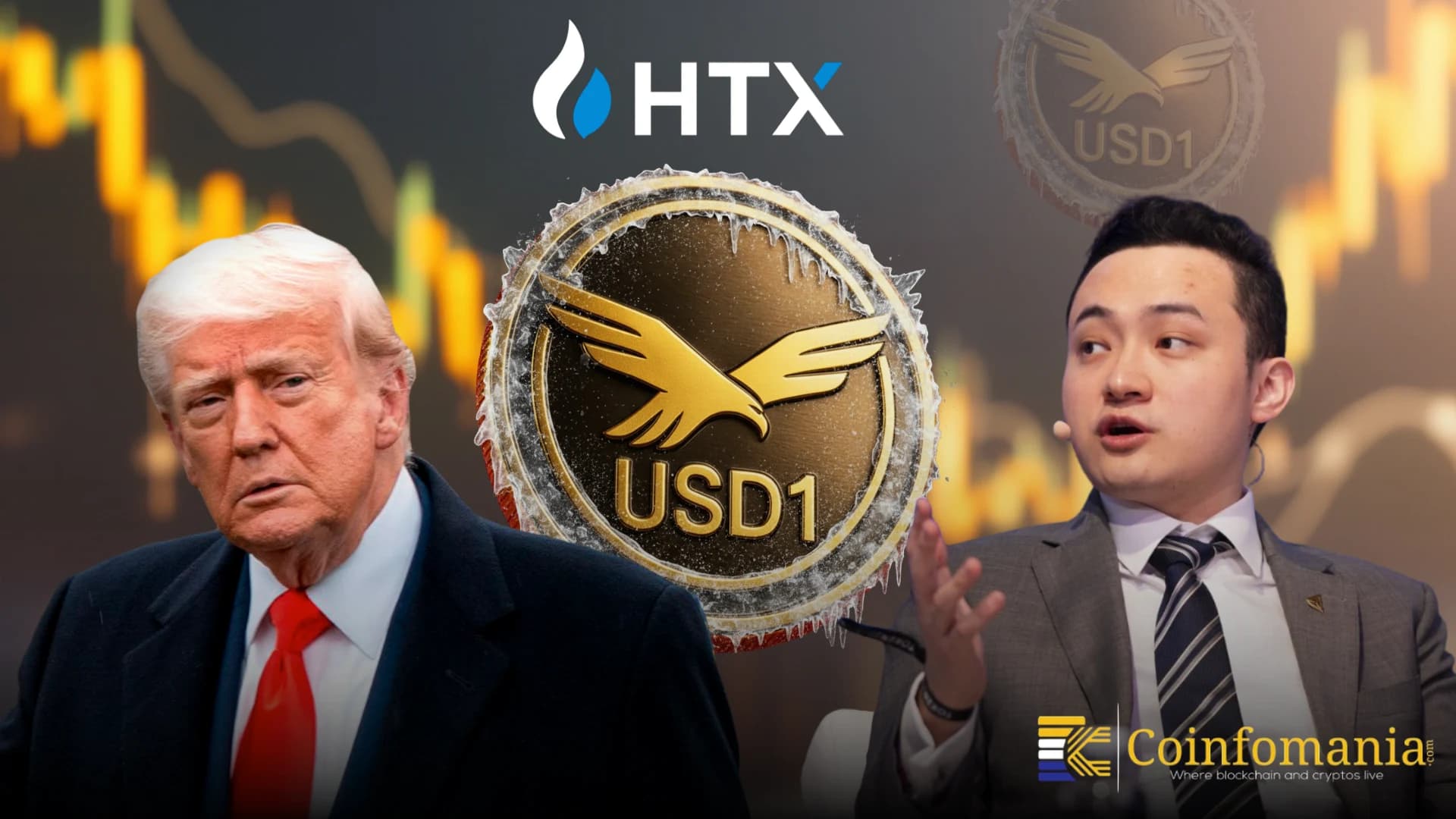
Justin Sun’s HTX Delists Trump’s USD1 After On-Chain Address Freeze

Justin Sun's HTX delists Trump-backed World Liberty Financial's USD1 stablecoin following a compliance-driven freeze on exchange addresses.
Quick Take
Summary is AI generated, newsroom reviewed.
HTX announced the total delisting of USD1 and will auto-convert eligible user balances to USDT at a 1:1 ratio.
World Liberty Financial froze the on-chain addresses to comply with risk-based sanctions reviews after recent UK regulatory actions.
The move escalates an ongoing legal battle between Justin Sun and the Trump-backed crypto project over smart contract controls.
UK authorities recently designated Huobi Global S.A. under its Russia sanctions framework for allegedly moving billions in shadow funds.
The feud between Justin Sun and Trump-backed World Liberty Financial (WLFI) has taken yet another ugly turn. HTX is a crypto exchange closely associated with Justin Sun. It has announced it will delist the USD1 stablecoin after claiming that World Liberty Financial froze several exchange-linked blockchain addresses.
🔥 JUSTIN SUN-LINKED HTX DELISTS TRUMP FAMILY'S USD1
— Coin Bureau (@coinbureau) June 8, 2026
HTX, a crypto exchange reportedly owned by Sun, has delisted $USD1 after claiming Trump's World Liberty Financial froze some of its on-chain addresses.
HTX says it may pursue legal action if the freeze is not reversed.
Sun… pic.twitter.com/E9fxOsJw2a
The move escalates a conflict that has already landed in courtrooms. It’s raising serious questions about stablecoin control, sanctions compliance and the risks that come with centralized freeze mechanisms.
HTX Moves to Delist USD1
HTX will remove USD1 trading entirely and convert eligible user balances into USDT at a 1:1 ratio, with the delisting set to take effect on June 7. The exchange had already pulled the plug on several trading pairs beforehand, including USD1/USDT, BTC/USD1, ETH/USD1, and WLFI/USDT.
In HTX news, the exchange was blunt about what triggered the decision. World Liberty Financial had frozen specific on-chain addresses linked to the platform, restricting asset circulation and creating risk for users.
“HTX believes that the WLFI project team’s unilateral freezing of these addresses, conducted without sufficient prior communication or transparent disclosure, directly infringes upon the legitimate rights and interests of HTX users,” the exchange stated.
Address Freeze Deepens Existing Feud
This dispute has been building for months. In what became one of the most talked-about moments in Trump crypto news, Justin Sun sues World Liberty after alleging that WLFI used hidden contract controls to freeze investor assets without warning. WLFI fired back with its own lawsuit, accusing Sun of defamation and violations tied to WLFI token sales. It sent the WLFI token price into turbulent territory.
Now USD1 has entered the middle of it all. HTX spokesperson Molly Fu pushed back firmly on the freeze, writing on X: “These are assets legally purchased and owned by individual users,” and calling on WLFI to reverse course. World Liberty Financial has yet to publicly respond to the allegations.
Sanctions Concerns Enter the Picture
The timing adds another uncomfortable layer. UK authorities recently sanctioned Huobi Global S.A., citing alleged links to sanctions evasion networks. HTX maintains the sanctioned entity is entirely separate from its current operations and that users are unaffected.
WLFI has previously stated that transactions involving sanctioned entities could face restrictions under its compliance policies. But whether those policies drove the HTX-linked freeze remains publicly unconfirmed, fueling speculation across the industry.
Stablecoins Face New Questions
At its core, this dispute puts a spotlight on a tension that has long simmered in crypto markets. Stablecoins are marketed as freely flowing blockchain assets. Yet most major issuers retain the ability to freeze addresses when compliance concerns arise. Supporters say those controls are necessary for regulatory reasons. Critics argue they introduce centralization risks that undermine blockchain’s core promise. The HTX-WLFI saga has become one of the starkest examples of that tension playing out in the open.
What This Means for Developers and Investors
For developers, the HTX delisting incident is a pointed reminder that stablecoin infrastructure often comes with centralized controls baked in. For investors, the delisting adds uncertainty around both USD1 and the broader WLFI ecosystem. It underscores just how quickly access to digital assets can evaporate when issuers decide to act. With legal battles still unfolding, the outcome could leave a lasting mark on how the industry handles stablecoin governance and user protections going forward.
References


Follow us on Google News
Get the latest crypto insights and updates.