Senators Push State Oversight for Stablecoins Under GENIUS Act

Senators led by Cynthia Lummis urged the Treasury Secretary to provide guidelines for state-level stablecoin regulation under the GENIUS Act.
Quick Take
Summary is AI generated, newsroom reviewed.
Lawmakers requested written procedures and predictable timelines for states trying to certify local oversight rules as substantially similar to federal law.
The legislative framework allows state authorities to manage payment stablecoin issuers with 10 billion dollars or less in outstanding assets.
The bipartisan push emphasizes preserving the dual banking system to prevent smaller digital asset firms from facing forced centralization.
This policy debate runs parallel to the pending CLARITY Act, which seeks to divide spot commodity and crypto security jurisdictions.
A bipartisan group of U.S. senators is urging the Treasury Department to preserve state-level authority in stablecoin regulation. They are arguing that smaller issuers should not be forced into a fully centralized federal oversight model under the GENIUS Act.
Led by Sen. Cynthia Lummis, along with Senators Kirsten Gillibrand and Bill Hagerty. Lawmakers sent a letter to Treasury Secretary Scott Bessent on June 16 requesting greater clarity on how states can qualify to supervise payment stablecoin issuers under the legislation.
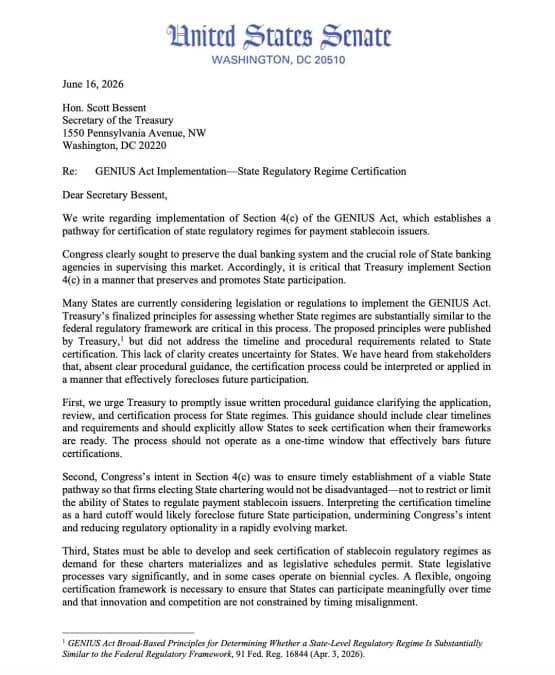
US Senate Letter to Treasury Secretary Scott Bessent on GENIUS Act Implementation. Source: US Senate
The debate comes as implementation of the GENIUS Act enters a critical phase. This marks one of the most significant stablecoin regulation updates in the United States this year.
Senators Seek Clear Rules for State Participation
The lawmakers emphasized that Congress intended to preserve the country’s dual banking system. By allowing states to continue playing a meaningful role in supervising digital asset businesses. Under the law, stablecoin issuers with less than $10 billion in assets may operate under state supervision. If their regulatory frameworks are deemed “substantially similar” to federal standards. Larger issuers would remain under direct federal oversight.
Currently, only a handful of major stablecoins, including Tether’s USDT, Circle’s USDC and USDS, exceed the $10 billion threshold.
In their letter, senators requested Treasury provide:
- Clear application and certification procedures for states.
- Defined review timelines.
- An ongoing certification process rather than a one-time approval window.
- Flexibility for states with varying legislative schedules.
According to lawmakers, failure to provide procedural guidance could discourage innovation and limit future state participation in the growing stablecoin sector.
Why the Debate Matters
The issue highlights a broader policy question shaping digital asset regulation. Should oversight be concentrated in Washington, or should states retain authority to foster competition and innovation? Supporters of the state-based model argue that local regulators have historically played an important role in financial oversight. It can respond more quickly to emerging technologies.
They also believe a competitive regulatory environment could encourage new entrants into the stablecoin market. While maintaining strong consumer protections. The discussion arrives amid increasing institutional interest in stablecoins. With financial firms preparing products designed to comply with the new regulatory framework.
Lummis Continues Push for Broader Crypto Rules
The latest development also intersects with ongoing efforts surrounding the CLARITY Act, another major digital asset bill moving through Congress. Sen. Cynthia Lummis has been one of the legislation’s strongest advocates. She is arguing that clearer rules are necessary for innovation and consumer protection. The bill would divide oversight responsibilities between the SEC and CFTC. While providing legal certainty for developers, stablecoin issuers and decentralized finance projects.
Recent statements from Lummis emphasized that the CLARITY Act would introduce modern disclosure standards. It will support self-custody rights and allocate additional resources to law enforcement agencies investigating crypto-related fraud.
As lawmakers continue negotiations on the GENIUS Act and CLARITY Act. The outcome could significantly shape the future of U.S. digital asset regulation. For investors, businesses and policymakers following crypto news today, the decisions made in Washington over the coming months. That may determine how innovation and oversight coexist in the next generation of financial infrastructure.


Follow us on Google News
Get the latest crypto insights and updates.